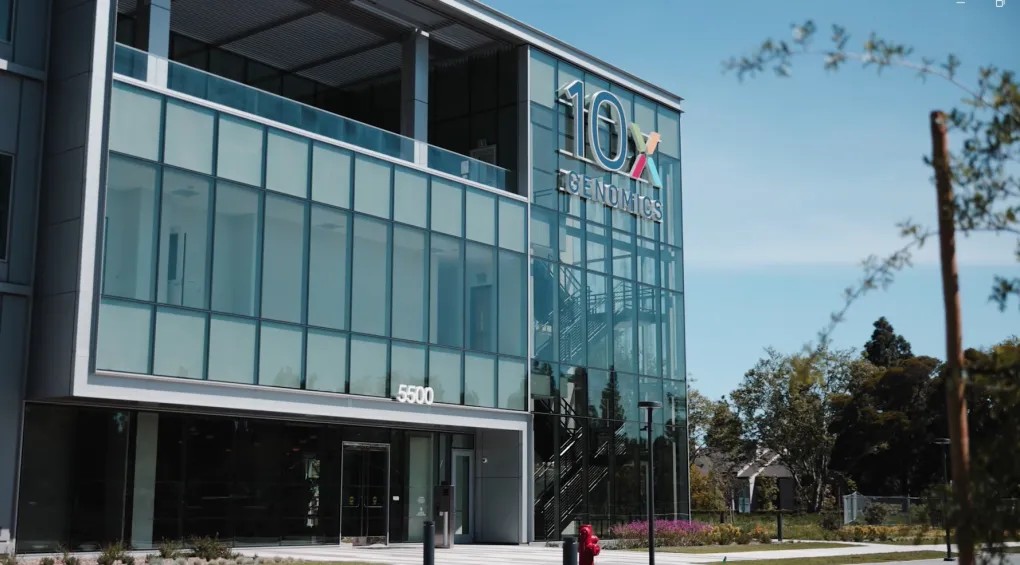

10x Genomics has joined with two licensor partners to administer a double dose of litigation to Illumina, filing a pair of federal lawsuits accusing the sequencing giant of infringing on nine patents related to spatial biology and single-cell sequencing.
In the spatial bio lawsuit, 10x joined Prognosys Biosciences in accusing Illumina of infringing upon four patents licensed by 10x from assignee Prognosys. In the single-cell lawsuit, 10x teamed up with Roche Sequencing Solutions to accuse Illumina of infringing on five additional patents—three assigned to 10x, and two licensed by 10x from the unit of Roche’s Diagnostics division.
In both cases, 10x, Prognosys, and Roche have asked the court to find Illumina infringed the patents in question, issue a permanent injunction barring Illumina from using technologies based on the patents, and assess against Illumina unspecified damages “adequate to compensate for damages resulting from Illumina’s infringement, including lost profits but in no event less than a reasonable royalty,” plus attorneys’ fees and “such other and further relief as the Court may deem just, reasonable, and proper.”
“Illumina strongly denies these claims and will vigorously defend ourselves against them,” the company said in a statement through a spokesperson.
Illumina noted that the lawsuits are not the first time 10x has sued a competitor. Through the latest lawsuits, 10x has resumed aggressively litigating against rivals, months after settling a pair of court challenges with two other competitors, Bruker and Vizgen.
The targets of 10x’s lawsuits have accused the company of stifling innovation through costly litigation—an argument also made by a group of academic researchers in a pointed commentary published last year in GEN. 10x denies that assertion and has defended its lawsuits as necessary to protect its innovation.
Both lawsuits were filed Tuesday in U.S. District Court for the District of Delaware. Both have been assigned to District Judge Maryellen Noreika, a former patent attorney who was nominated to her position in 2017 by President Donald Trump.
The spatial biology lawsuit is Case 1:25-cv-01286-UNA. The single-cell sequencing lawsuit, Case 1:25-cv-01286-UNA.
Asserting four spatial patents
In the spatial biology lawsuit, 10x and Prognosys allege that the spatial transcriptomics technology announced by Illumina in February infringes upon four patents licensed by 10x from Prognosys.
Days before the 2025 Advances in Genome Biology and Technology (AGBT) General Meeting, Illumina signaled its intent to expand its genomics leadership beyond its specialty of next-generation sequencing (NGS), into the spatial field. Illumina unveiled a spatial technology program that is designed to let researchers examine the spatial proximity of millions of cells per experiment, using what Illumina says is a capture area nine times larger and with four times greater resolution than current technologies.
At AGBT, Illumina highlighted researchers from the Broad Institute, St. Jude Children’s Research Hospital, and TGen who shared data on their use of Illumina’s spatial technology—which is compatible with Illumina’s NextSeq and NovaSeq sequencers and uses a new multimodal analysis platform.
Illumina’s spatial tech announcement placed the company among “Up & Comers” in spatial biology highlighted by GEN earlier this month.
The spatial lawsuit centers on four patents covering technologies awarded between 2021 and this year, and all titled, “Spatially Encoded Biological Assays: U.S. Patent Nos. 11,008,607 (‘607), issued May 18, 2021; 11,549,138 (‘138), issued January 10, 2023; 12,234,505 (‘505), issued February 25; and 12,297,487 (‘487), issued May 13.
“High levels of multiplexing”
“The invention provides an assay system comprising an assay capable of high levels of multiplexing where reagents are provided to a biological sample in defined spatial patterns; instrumentation capable of controlled delivery of reagents according to the spatial patterns; and a decoding scheme providing a readout that is digital in nature,” according to the abstract of each patent.
Technologies covered by the four patents were invented by Mark Chee, PhD, who co-founded Illumina in 1998 and served as vice president of genomics and informatics before moving to other genomics tools companies. Chee was CEO/CSO of Prognosys before co-founding Encodia, where he is now president and CEO.
This is not 10x’s first lawsuit focused on defending the ‘607 patent. In November 2023, a jury in the same court awarded 10x $31 million after finding that NanoString Technologies had infringed upon the ‘607 patent and six other patents 10x licenses from Prognosys in developing the GeoMx® Digital Spatial Profiler (DSP).
NanoString blamed the jury award in filing for protection from creditors under Chapter 11 of the U.S. Bankruptcy Code in February 2024. By May of that year, Bruker completed its acquisition of NanoString after placing the winning $392.6 million bid at a bankruptcy court auction.
10x and Bruker settled the NanoString litigation in May, with 10x announcing at the time that Bruker agreed to pay it $68 million in equal quarterly installments between the third quarter of 2025 and the second quarter of 2026, plus ongoing royalties on sales of its spatial biology products through the life of the licensed patents.
NanoString, since absorbed into Bruker’s Spatial Biology Group, is one of several competitors sued by 10x in the spatial biology field. Others include:
- Curio Bioscience, acquired in January by Takara Bio USA. Earlier this month, Takara launched an expanded portfolio of spatial biology products designed to broaden the technology’s reach to more researchers.
- Vizgen, which in February settled with 10x; the companies have since differed publicly about the terms of their settlement.
Speaking with GEN in May, 10x CEO Serge Saxonov, PhD, defended 10x’s litigation strategy against competitors.
“At 10x, we’ve always believed that bold, original science must be protected, not just for the benefit of a company, but for the entire scientific ecosystem,” Saxonov added. “It’s imperative for us to protect our inventions, given how much we invest and how important that is to the mission of the company. And if others end up infringing and copying our inventions, then we have to protect them. It is incumbent on us, both as a means of serving our mission and as a means of being fair to all our stakeholders.”
Five single-cell patents at issue
In the single-cell lawsuit, 10x teamed up with Roche Sequencing Solutions to accuse Illumina of infringing on five additional patents—three assigned to 10x, and two licensed by 10x from the unit of Roche’s Diagnostics division.
10x is the licensee for two of the five patents in the case, both of which the company licenses from Roche Sequencing Systems. Both cover the same technology, “Barcoded Beads and Method and Making the Same by Split-Pool Synthesis,” and consist of U.S. Patent Nos. 11,692,214 (‘214), issued July 4, 2023; and 11,932,902 (‘902), issued March 19, 2024.
According to the abstract for the ‘214 patent, Roche Sequencing states that the covered invention “provides methods, compositions, kits and devices for the detection of target molecules. In some embodiments, the invention allows for multiplexed target molecule detection.”
As for the ‘902 patent, its abstract states that it covers a method that entails “splitting a pool of beads into a plurality of reaction volumes, appending pre-made oligonucleotides onto the beads in the reaction volumes, wherein at least some of the reaction volumes each receive an oligonucleotide that contains a sequence that is different from the other oligonucleotides added to the reaction volumes, pooling the beads and repeating the splitting, appending and pooling steps one or more times to produce a pool of beads that comprise the cell origination barcodes.”
“In the one or more repeats the oligonucleotides that are appended are added to previously appended oligonucleotides to form the cell origination barcodes,” Roche Sequencing added.
Both barcoded bead patents are called the Nolan Patents after the inventor listed on them, Garry P. Nolan, PhD, the founder of Apprise, a developer of single-cell analysis technology acquired in 2017 by Roche Sequencing Solutions.
Nolan—now the Rachford and Carlota A. Harris professor in the Department of Pathology at Stanford University School of Medicine—was also a founder or co-founder of numerous other companies, including Bina Technologies, the developer of a big data platform for centralized management and processing of NGS data for academic and translational research, acquired in 2014 by Roche and integrated into Roche Sequencing Solutions; Nodality, a defunct developer of diagnostics based on its single-cell network profiling technology; and Akoya Biosciences, acquired by Quanterix in a deal completed in July.
Sequence analysis, droplet transfer patents
Also at issue in the single-cell lawsuit are three patents assigned directly to 10x. Two of the 10x patents cover “Analysis of Nucleic Acid Sequences,” Nos. 12,275,993, issued April 15 of this year; and 12,305,239, issued May 20. “The present disclosure relates to methods, compositions and systems for droplet processing,” 10x stated in its abstracts for both patents.
10x explained in the abstracts for both analysis patents that the covered methods can include:
- Providing two emulsions. One consists of a first droplet population, where droplets comprise a lysis reagent. The other emulsion consists of a second droplet population, where a droplet comprises a cell or a nucleus, and a plurality of nucleic acid barcode molecules.
- Subjecting both emulsions to conditions sufficient to transfer the lysis reagent to the second droplet population via micelles comprising the lysis reagent.
- Lysing the cell or the nucleus within the droplet of the second droplet population with the lysis reagent.
The third 10x patent, No. 12,416,102, was issued September 16 and covers “Systems and Methods for Transfer of Reagents Between Droplets,” including a method providing for a first and a second droplet.
“In some cases, the first droplet may have a first concentration of a reagent and the second droplet may have a second concentration of the reagent. The second droplet may comprise a bead or a biological particle,” 10x stated in the patent abstract. “The method can also include subjecting the first droplet and the second droplet to conditions sufficient to transfer the reagent from the first droplet to the second droplet, thereby decreasing the first concentration in the first droplet and increasing the second concentration in the second droplet.”
The lawsuits contrast with the cooperative relationship 10x and Illumina have shown previously. 10x’s Visium Spatial Gene Expression Solution produces spatially barcoded libraries compatible with eight Illumina sequencers. And in 2016, the companies inked a co-marketing agreement intended to co-promote Illumina sequencing systems and 10x’s Linked-Read sequencing products, which were discontinued in 2020 after Bio-Rad Laboratories sued 10x, alleging its patents were infringed. (Bio-Rad partnered a year later with Illumina to launch a single-cell sequencing solution).
Withstanding research spending cuts
Based in Pleasanton, CA, 10x is a leading developer of instruments, reagents, and software used for spatial and single-cell biology. Like other genomics tools developers, 10x has withstood a slowdown in spending by the majority of its customers in academia due to federal cuts in research funding. In May, 10x eliminated 8% of its workforce—about 100 jobs—as part of a company effort to cut $50 million in costs and better reflect strategic priorities.
10x finished the first half of 2025 with just $180,000 in net income, an improvement over its $97.846 million loss for Q1-Q2 2024, on revenue that rose 11.5% to $327.791 million from $294.110 million in January-June of last year.
10x plans to report third quarter earnings on November 6 after the close of financial markets.
In an October 13 research report Puneet Souda, senior managing director, life science tools and diagnostics and a senior research analyst with Leerink Partners, commented that the prospects of 10x recovering in the second half of this year are tied to the flow of NIH funding. U.S. academic and government research funding supports approximately 40% to 50% of the company’s revenue, the company has said.
“We believe NIH cuts, including the potential 15% cap on indirect costs, poses a significant threat. We have no visibility as to when the risk of these cuts will be resolved—and neither do the academics who are making spending decisions—which significantly increases the risk to TXG revenues,” Souda wrote. “There appears to be no solution in the near term and may require congressional solution, which itself remains uncertain.”
Beyond NIH funding, he added, 10x faces stiff competition from competitors offering instruments-free single-cell technologies at lower prices.
“The competition is likely to only get worse while China geopolitical risk rises and TXG remains in litigation on both single-cell and spatial business. Their single-cell IP [intellectual property] moat is eroding and the outcome on spatial IP remains uncertain,” Souda observed.